Beyond GDP: Degrowth and Wellbeing
What does it mean to move beyond GDP, and what would it look like inside a real, high-income economy? For decades that question has been argued in mostly qualitative terms. A study by the Millennium Institute, Stockholm Environment Institute, and Stockholm Resilience Centre takes a quantitative approach to it, simulating a package of degrowth policies for Sweden through to 2050 and tracing how they ripple across the economy, society, and environment.
Published in Ecological Economics and co-authored by MI Chief Scientist Matteo Pedercini, the study uses the iSD (Integrated Sustainable Development Simulator) model, adapted to Sweden, to bring a simulated perspective to the debate about going beyond GDP. Its central finding is as much about policy design as about degrowth itself: the policies work only when applied together as a coherent package. In isolation, each one creates a trade-off.
The Limitations of GDP as a Measure of Success
Why Gross Domestic Product Fails to Reflect True Progress
GDP captures the market value of goods and services produced. It leaves out how that output is created, what it costs the environment, and whether it makes people's lives better. As a measure, it rewards production over wellbeing.
The study's premise is that, beyond a certain threshold, additional GDP growth adds only marginally to wellbeing, and the gains tend to accumulate with those already wealthy rather than reaching those in need. A rising GDP can mask deepening inequality and mounting environmental pressure. The research proposes treating GDP as one indicator among many, not as the goal.
Environmental Degradation and the Cost of Infinite Growth
The idea that growth can be fully decoupled from environmental harm, the promise of green growth, is increasingly contested. Economy-wide rebound effects, where efficiency gains lower costs and stimulate additional production and consumption, can offset the savings efficiency was meant to deliver. The research indicates that high-income countries may need rapid reductions in material and energy use, not just a slower rate of increase.
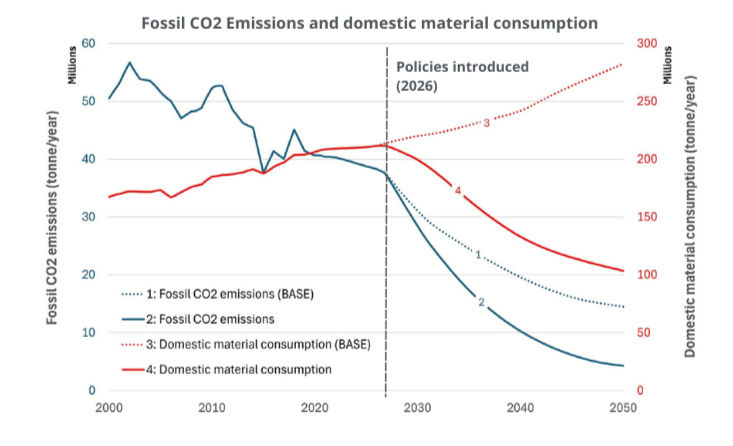
The simulation quantifies what that looks like. Under the degrowth scenario, fossil CO₂ emissions fall by roughly 89% by 2050, domestic material consumption by 51%, and energy consumption by 36%. These are not the marginal improvements of efficiency gains. They reflect a structural shift: producing less of the things with the highest material and energy intensity, rather than trying to make ever more of them with slightly less impact.
Understanding the Core Principles of Degrowth
What Degrowth Means
Degrowth is a response to the limits of GDP-first development. It does not translate into recession or austerity. The study adopts the definition of degrowth as:
"an equitable downscaling of production and consumption that increases human wellbeing and enhances ecological conditions at the local and global level, in the short and long term."
Degrowth is not simply less, it is less of what damages the planet and does little for wellbeing, paired with more of what people need: security, time, and a livable environment. The study treats it as a transition rather than a permanent shrinking, with the economy settling into a steady state defined by qualitative improvement rather than continuous quantitative growth.
Policies for Degrowth
The study drew on a systematic review of the degrowth literature that catalogued hundreds of proposed measures, then selected on two grounds: how often each policy appears in that literature, and whether it could be meaningfully represented in the iSD model. Each was tested both on its own and as part of the package:
Corporate taxes targeted at high-footprint sectors
Capital decommissioning of environmentally harmful production
A fossil fuel phase-out
Strongly progressive taxation, including a maximum income
A universal basic income
A ~45% reduction in working hours
A global redistribution mechanism for surplus government revenue
Downscaling Production and Consumption for Ecological Balance
Reductions in material and energy consumption are central to degrowth. Two policies do most of this work: the first is corporate taxes, set highest on the most polluting, resource-heavy sectors. The second is capital decommissioning: each year, a set share of the most environmentally harmful production capacity is retired. The rate is highest for livestock and industry, lower for other sectors, and zero for services, which are left untouched.
These two policies target which production is scaled down, and how. The result is an economy that contracts where it does the most ecological harm and the least social good, while the sectors that sustain wellbeing are protected.
Downscaling harmful production cuts emissions and material use sharply, but it also reduces labor demand, which on its own raises unemployment and poverty. That is why the downscaling policies are not meant to stand alone. They are paired with the redistributive and work-sharing measures that follow.
Policy Strategies for a Post-Growth Future
Three of the strategies carry the most weight for society and public finances. Each reveals a trade-off when it stands alone, and only resolves it in combination with the others.
Shifting Taxes from Labor to Resource Consumption
A recurring post-growth principle is to tax what we want less of, high-footprint production and excess income, rather than work itself. In the Sweden package this works on two fronts: corporate taxes levied at the sector level, highest on livestock and industry, and fully progressive personal taxation that tops out at a rate functioning as a maximum income. Together these redirect investment and fund redistribution.
In the short run, the added revenue is enough to cover the universal basic income and even generate a surplus for global redistribution. But the study flags a long-run risk honestly: as GDP contracts, tax revenues fall with it, the government moves into deficit, and the debt-to-GDP ratio rises.

Investing in Public Services and Universal Basic Income
If people are to work and earn less, security has to come from strong public provision. The study models a universal basic income that replaces existing benefits and transfers, alongside healthcare and education spending held constant in real per-capita terms even as GDP falls.
On its own, the basic income reduces poverty and inequality powerfully but is fiscally unsustainable, driving a growing deficit. Paired with the tax reforms, it becomes affordable in the near term. This dependency is exactly what the coherent-package finding is about: a redistributive policy that works only when a matching revenue policy funds it.
Reducing Working Hours to Improve Quality of Life
Work-time reduction is one of the most powerful levers in the package, and the most double-edged alone. The study models a smooth transition to about 55% of current full-time hours over roughly 25 years. The mechanism is job-sharing: as hours per person fall, more people are needed to produce the same work, so unemployment initially drops before climbing back toward business-as-usual levels later in the simulation as production is deliberately downscaled. The result avoids the mass unemployment critics of degrowth often assume. On its own, though, shorter hours stabilize employment without shifting environmental outcomes much. The emissions gains come from the production-side policies it is paired with.
Putting Wellbeing at the Center of Economic Models
What Is a Wellbeing Economy?
A wellbeing economy is one where meeting human needs is no longer tied to GDP growth. The study builds on the idea that beyond a certain point, more output does little for wellbeing, and that what sustains people, secure incomes, healthcare, education, a livable environment, can be protected even as the economy contracts.
If GDP is not the right yardstick, what should replace it? The study tracks a broad dashboard of social, environmental, and economic indicators at once, and judges policy by how it moves all of them together rather than by whether the economy grew.
The research models eight key indicators side by side:
Fossil CO₂ emissions
Domestic material consumption
Relative poverty
Unemployment
The Gini coefficient
GDP per capita
Debt-to-GDP
The government's operating balance
Success is defined not as a bigger economy but as environmental pressures falling while poverty, inequality, and unemployment fall too.
Metrics That Matter: Equity, Poverty, and Employment
Equity is where the model shows its clearest results. In the degrowth scenario, income inequality compresses sharply, with the Gini coefficient falling from 0.30 in 2026 to 0.12 by 2050, while relative poverty drops by about 25% despite a contracting GDP per capita. The decline in disposable income is concentrated at the top, through strongly progressive taxation that reaches an effective maximum income. In other words, the cost of the transition is borne by those most able to absorb it. The model also holds real per-capita healthcare and education spending constant even as GDP falls, treating them as too important to scale down.

The Coherence Principle
Policy coherence is a precondition. Each policy fills a gap another would otherwise leave open, and the interactions between them are what make the package work. A degrowth transition can deliver environmental improvements and meaningful social gains in a high-income country, but only if its policies are designed to work together, and only in its early stages. Preserving those gains over the longer term would require deeper structural reforms to welfare and financial systems, which the study identifies as the crucial next question.
The full paper is open access in Ecological Economics*: Zwetsloot, K., Collste, D., Bennich, T., Hahn, T., & Pedercini, M. (2026). Modelling degrowth policies with system dynamics: Towards policy coherence. DOI: 10.1016/j.ecolecon.2026.109045*


Comments