What would degrowth actually look like? A new study models the answer for Sweden
A new study applies the Millennium Institute's Integrated Sustainable Development (iSD) model to Sweden to test what would happen if a degrowth policy package were implemented. The key finding: when policies act in isolation they create significant trade-offs. When designed as a coherent whole, environmental and social outcomes improve together — though preserving these gains in the long term would require deeper structural reforms to welfare and financial systems.

For decades, climate policy has relied on the idea that the economy can keep growing while its environmental footprint shrinks. The evidence that green growth is happening fast enough — or at all — is increasingly contested. A growing number of studies argue that high-income economies need a different strategy: deliberately reducing material and energy use while protecting, and even improving, social outcomes.
Until recently, much of the policy discussion around degrowth has remained qualitative. What does a degrowth transition actually look like inside a real national economy? Which policies pull which levers? Where do they reinforce each other, and where do they collide?
The study, published in Ecological Economics, co-authored by Matteo Pedercini, Chief Scientist at the Millennium Institute, puts these questions to a quantitative test. Using the iSD-Sweden model, the authors simulate a package of seven degrowth policies through to 2050 and trace their interactions across the economy, society and environment.
What was tested, and how
The iSD model is a simulation tool that lets users evaluate future scenarios under different conditions and policies, and see how a change in one part of the system ripples through the rest. For this study it was calibrated against more than 20 years of Swedish historical data, anchoring the simulations in the country's institutional and fiscal reality.
The policy package tested is ambitious. It includes:
Corporate taxes targeted at high-footprint sectors
Capital decommissioning of environmentally harmful production
A fossil fuel phase-out
Strongly progressive taxation, including a maximum income
A universal basic income
A ~45% reduction in working hours
A global redistribution mechanism for surplus government revenue
The environmental story: large, fast reductions
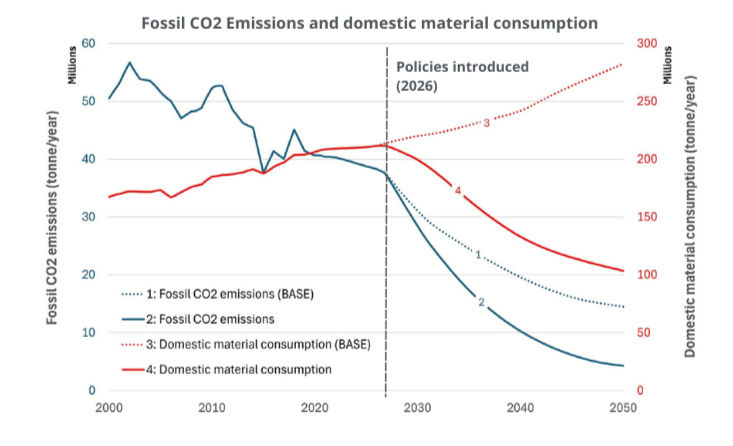
Under the degrowth scenario, fossil CO₂ emissions fall by roughly 89% by 2050 — far below the business-as-usual trajectory. Material consumption and energy use follow the same pattern, dropping sharply in absolute terms rather than just slowing down.
These are not the marginal improvements of efficiency gains. They reflect a structural shift: producing less of the things with the highest material and energy intensity, rather than trying to make ever more of them with slightly less impact.
The social story: poverty, inequality and employment
A common concern with degrowth scenarios is that scaling the economy down would disproportionately affect lower-income households — the people most exposed when employment levels fall. The simulations suggest the opposite, provided the redistribution mechanisms are switched on at the same time as the downscaling.
In the degrowth scenario, relative poverty falls and income inequality compresses sharply, driven by progressive taxation combined with the universal basic income. The decline in disposable income is concentrated at the top: the wealthiest see significant income reductions, while the 70% with lower incomes actually see their incomes rise in the short term. In other words, the cost of the transition is borne by those most able to absorb it.
Unemployment follows a similar pattern. When working hours are reduced, more people are needed to produce the same output, balancing unemployment in the short term before settling back near business-as-usual levels later in the simulation.

The economic picture
In a degrowth scenario, GDP is reduced — but this is not a failure. It is the mechanism by which environmental pressures are reduced.
In this scenario, increased tax revenues cover the universal basic income and other public expenditures, even generating excess funds for global redistribution. However, in the long term, GDP contracts and tax revenues fall with it, while government debt grows. The study makes it clear that the later stages of a degrowth transition would require deeper structural reforms — to welfare systems, and possibly to the financial system itself — to preserve citizens' wellbeing over time.
Why policies in silos fall short
One of the key findings of this study is that the policies do not work in isolation. When applied separately, the policies produce trade-offs:
Downscaling harmful production cuts emissions, but raises unemployment.
A universal basic income reduces poverty, but is fiscally unsustainable on its own.
Work time reduction stabilises employment, but on its own does not shift environmental outcomes enough.
Combined, these trade-offs largely dissolve. Each policy fills a gap that another would otherwise leave open: the interactions between them are what make the package work — not the strength of any single measure.
The simulations point to a clear conclusion: a degrowth transition can deliver environmental improvements and meaningful social gains in a high-income country — but only if its policies are designed to work together. Policy coherence is not a nice-to-have. It is the precondition.
The full paper is open access in Ecological Economics: Zwetsloot, K., Collste, D., Bennich, T., Hahn, T., & Pedercini, M. (2026). Modelling degrowth policies with system dynamics: Towards policy coherence. DOI: 10.1016/j.ecolecon.2026.109045
Comments